
A reckoning, a reprieve… And another reckoning
The Nasdaq fell just shy of 3% last Friday, with many AI shares falling harder, after earnings split the biggest AI spenders. Alphabet missed in search and advertising as growing use of its AI mode, which earns less per query, ate into its core profits, and ended roughly 17% below its 200-day moving average – see Figure 1. Microsoft was close to flat after spending less on capital expenditure (“capex”) than expected and generating more free cash flow.

Figure 1 – Alphabet has broken below its 200-day moving average
Following Wednesday’s brief recovery in markets, and energy moderation, the Friday reckoning on the AI trade now looks more like part of a geopolitical story than any verdict on AI fundamentals. During October, Brent rose over 13.0% and peaked around $118 as Iran stepped up its Hormuz activity before the US midterms. Parallel to this, the Nasdaq’s 6.7% fall over the month could be attributed to that risk premium, the extra price markets add to oil for the danger of supply disruption.
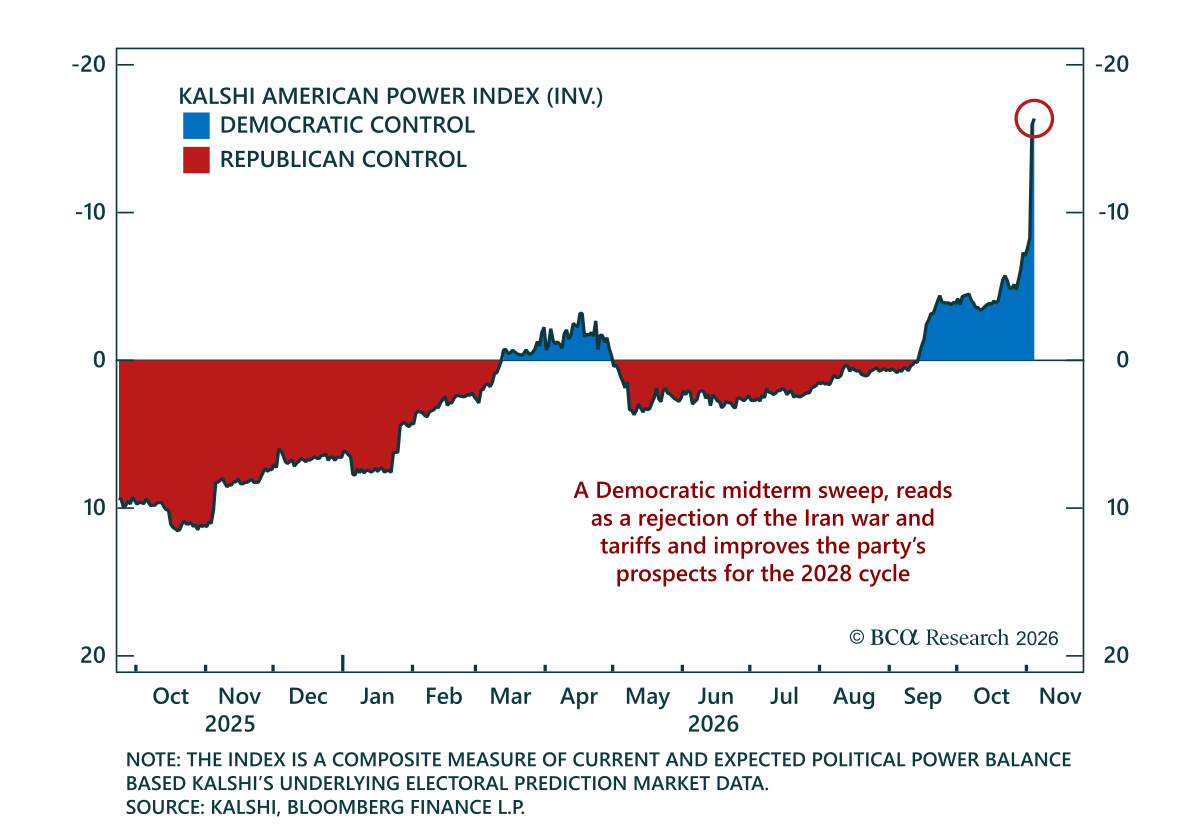
Figure 2 – Prediction markets priced a Democratic sweep
Markets, led by the hyperscalers, first rallied following the midterm result. Democrats were able to convert previously deep-red states such as Texas and Iowa, implying voters have begun to reject the policies behind the inflationary effects of the Iran war and tariffs – see Figure 2. Oil has now fallen more than 15% over the last week, and yields, alongside the dollar, have declined. While the Democratic sweep will help moderate any foreign policy escalation, uncertainty regarding a tighter regulatory environment on the AI buildout, alongside the potential for a final face-saving provocation by Trump in Iran, have kept markets on a knife’s edge.
Against this backdrop, the dam walls broke once again on Thursday. On the day alone, the S&P 500 fell 4% and the Nasdaq 100 was down over 6%. The extent of the drop does point to the possibility of forced liquidations (e.g. margin calls amplifying the underlying move).
While certain hyperscalers have been able to keep their downside risk moderate over the week, chipmakers have remained under pressure throughout. The Philadelphia Semiconductor Index fell over 12% on Thursday, close to its worst daily performance since 2020 and cutting its year-to-date gain to below 26%, from 107% in June. This divergence suggests that, even as geopolitical risks are eventually faded out of share prices, the strength of the broader AI ecosystem will not necessarily lift all its participants equally. While the AI buildout still remains far from maturity in its investment cycle, the long-term competitive barriers across the different stages of the AI supply chain are becoming increasingly clear already. It is likely that underneath the volatility, investors are already allocating based on what part of the AI supply stream can guarantee its moat over the long-term.
Who owns the moats
On today’s snapshot, the AI ecosystem increasingly looks like a demand narrative with a growing overhang from return uncertainty. Demand is real and still capacity constrained. Hyperscalers hold nearly $2.4 trillion of contracted revenue still to be delivered, and Microsoft has disclosed about $80 billion of cloud orders it could not fill because of power limits.
The returns are the problem, and often the main driver behind sentiment volatility. The hyperscalers’ revenue over the past twelve months is about $1.9 trillion, and earning a fair return on capex of $1.4 trillion a year would need about $7.4 trillion, which means doubling sales twice in four years. While exact useful life is debatable, if we assume chips last only two to five years, against decades for railways or fibre, the payback has to arrive quickly.

Figure 3 – Chip rental prices are rising even as token prices fall
The cost of using the same AI model has fallen more than 80% since 2023, while the number of tokens (the units in which AI usage is billed) processed has risen about 330 times. However, falling token prices may not be the right signal to watch. If the downtrend continues, a price war could ensue among model providers, lifting demand for AI, and pushing GPU rental prices up. We have seen a glimpse of this so far. The rental price of Nvidia’s B200 chip has risen from about $4.4 an hour in December to about $6.5, all while token prices have more than halved since May – see Figure 3.
That being said, productivity evidence (the most developed selling point for AI so far) remains thin. Only 6% of respondents to a recent McKinsey survey attribute 5% or more of operating profit to AI, and much of the growth in token use comes from reasoning models and agents using more tokens per task (i.e. the transition from simple prompt-reply models to agentic services), which likely overstates any increase in useful work.
The moat comparison, per layer
The share of spending captured by each company ultimately depends on its position in the supply chain, as the durability of competitive advantages, or “moats”, varies across the different layers.
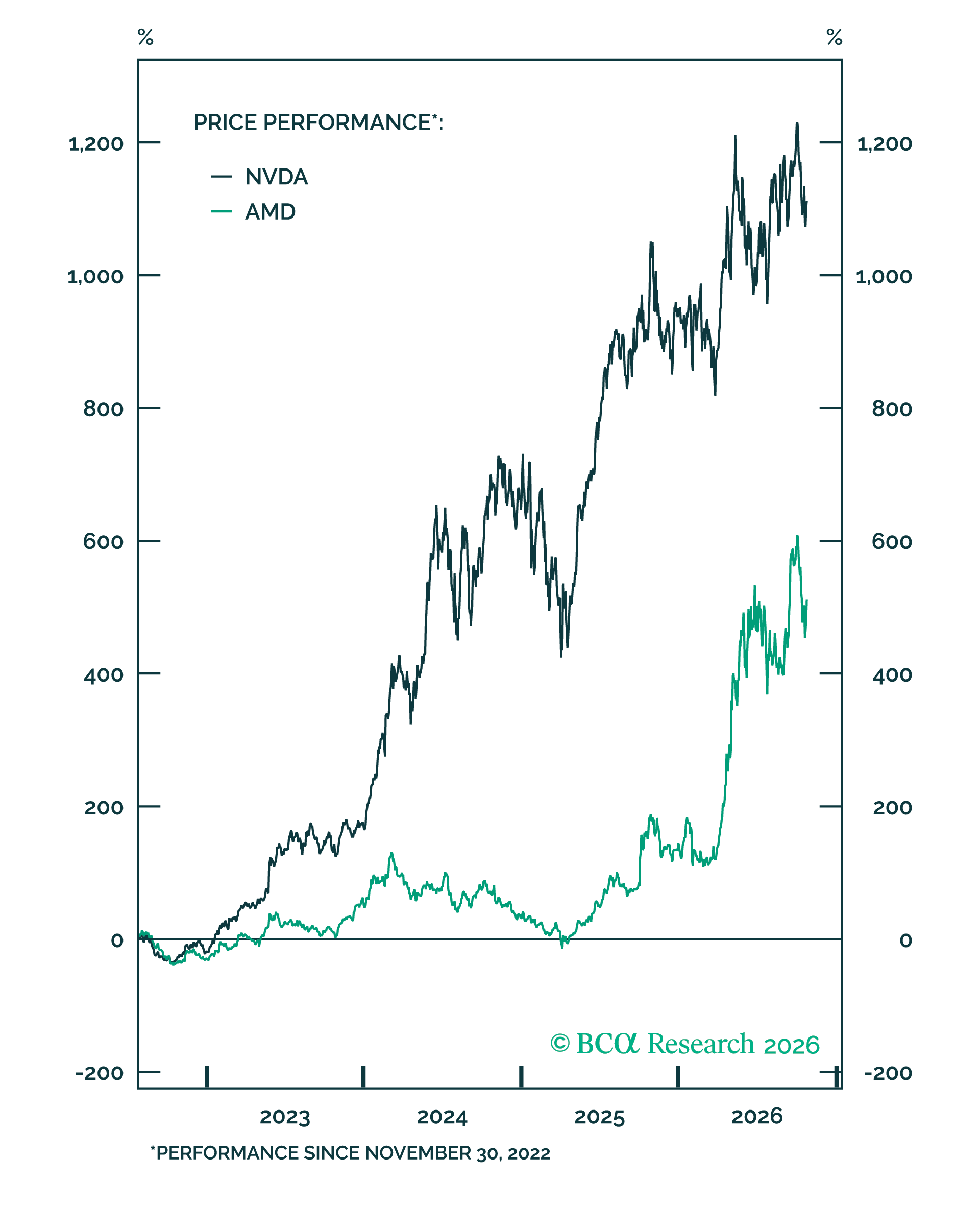
Figure 4 – AMD has narrowed the gap with Nvidia
At the chip layer, Nvidia’s near-monopoly is being challenged, with Meta and Microsoft deploying cheaper AMD chips to run models. Although these chips use more energy and need more configuration, their overall cost looks significantly lower for hyperscalers at scale, and AMD is up about 160% this year against a mid-teens gain for Nvidia – see Figure 4. Memory is a more defensible position, since only Samsung, SK Hynix and Micron can make high-bandwidth memory at competitive cost and no alternative technology is close.

Figure 5 – Neoclouds have destroyed value while hyperscalers have created it
Neoclouds, which borrow to buy chips and rent them out, are the weakest link, having so far earned less than their cost of capital while the hyperscalers earn well above it – see Figure 5.
To cover all bases, it is fair to admit that the neoclouds also have a counterargument. If Nvidia’s pricing power fades, their chip costs fall while rental rates stay set by demand, benefiting the neocloud providers. With rental prices for AI chips already up 40% since January, the sell-off in these shares may be overdone. However, that argument only holds if demand exceeds supply. In an environment of declining demand or excess supply, a neocloud that fills its inventory at peak chip prices may find its rental income falls short of depreciation, maintenance and interest. This is why, for investors maintaining AI exposure, the preference remains for hyperscalers over neoclouds.
On a more nuanced view, regulatory dynamics also play into this preference, with this week’s midterms reinforcing that idea. Tighter data centre restrictions in buildout states such as Texas, Georgia and Ohio, where Democrats have now flipped governorships, would increase the risk to future compute supply and thereby add value to existing capacity. Hyperscalers have already made strong progress in the buildout, as well as being big enough to diversify globally for future expansion, thus winning on both sides of this angle. On the other side, neoclouds, which are still early in their compute buildout and far more concentrated in the US, must rely on favourable regulation.
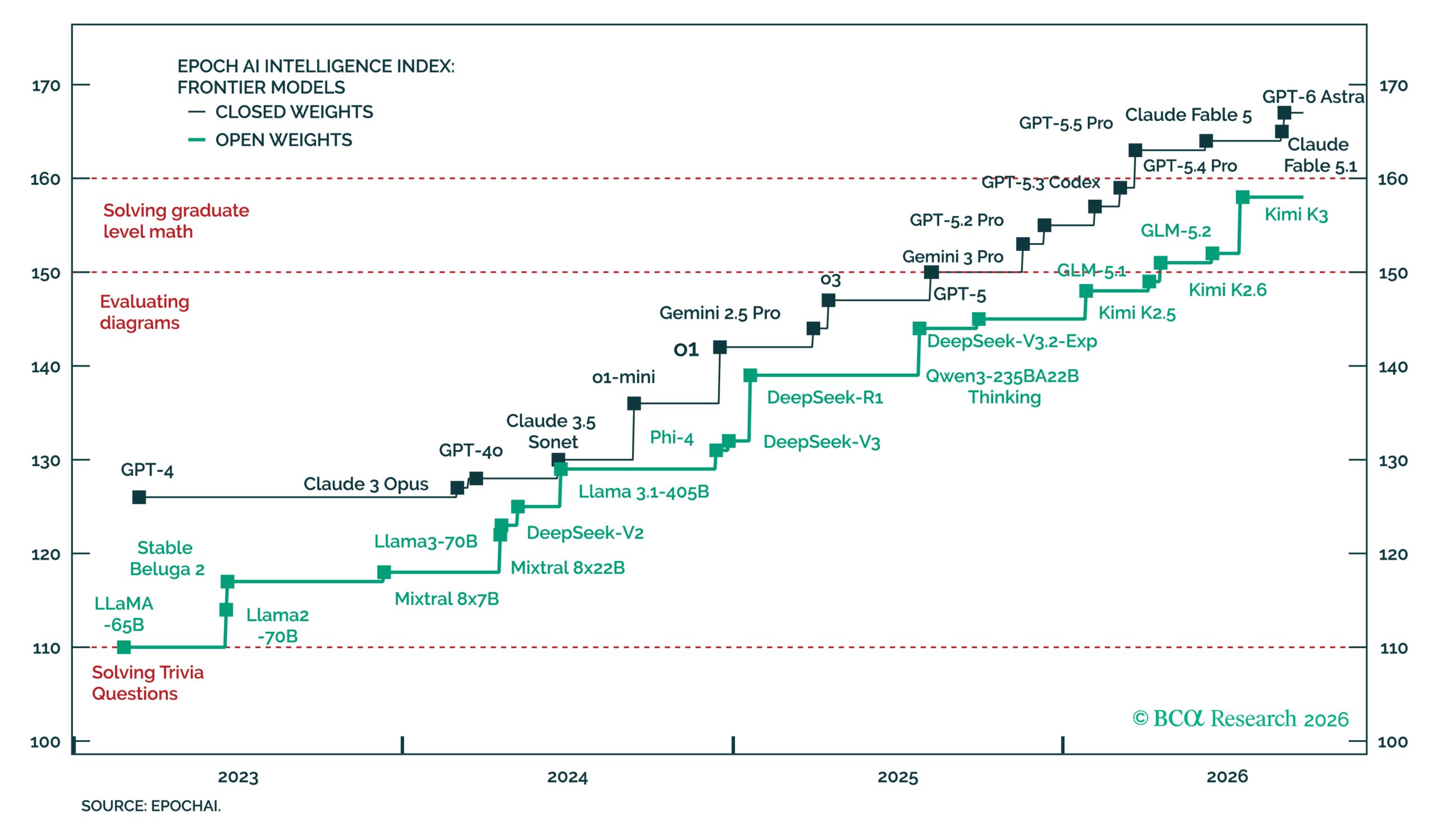
Figure 6 – Open-weight models tend to catch up with frontier models within a year
The moat for model developers is their ability to protect their lead in AI innovation against rivals (the first mover advantage), and it is the least certain in the AI chain. Anthropic and OpenAI, the leading developers known as frontier labs, are the clearest examples. Training a frontier model from scratch takes vast capital, electrical power and advanced hardware, but distillation offers a way around that. The process works by a rival training a new model on millions of prompts and answers that an established model (e.g. Claude or ChatGPT) gives, copying much of its behaviour at a fraction of the cost. The copies are never as good as the original, but they match much of its performance quickly and cheaply.
Pressure also comes from open-weight models (whose inner workings are published). Closed models have consistently led in performance, but open-weight models tend to catch up within a year – see Figure 6. The likely outcome is that both survive, with the frontier labs’ valuations depending on the share each type captures. Closed models should keep an edge in high-stakes work such as drug development or security analysis, while their hold on everyday uses depends on whether regulation makes open-weight models trustworthy enough for financial transactions and sensitive data. That leaves the labs’ long-run value resting on rules and use cases which are still taking shape.
Investment takeaway
The recent rollercoaster we are experiencing in tech is likely amplified by the macro. However, between the lines, it also reflected a reshuffling of the premium allocated to each layer of the supply chain. This was confirmed by seeing who benefitted in the subsequent recovery (hyperscalers over chipmakers), even if short-lived. Demand still exceeds supply and the buildout remains profitable, so it is too early to mark down any hyperscaler capex plans. But investors are increasingly rewarding companies that can already show AI investment converting into free cash flow and punishing those that cannot. This will continue to favour hyperscalers over neoclouds, and memory makers (whose moat is the most durable) over chip designers who face growing competition.
On this evaluation, a sensible strategy could be to own the companies already monetising their spending. The near-term backdrop stays constructive and turns on the Iran war, where capitulation by President Trump would be bullish for equities and bearish for energy. As mentioned, a final escalation before the new Congress sits remains a key risk in the near term.
If you are interested in finding out more about how cognisance of the macroeconomic backdrop impacts our investment decision making process, connect with Integrity Asset Management and let us help you navigate your investing journey.
For more information on this synopsis or to discuss solutions provided by Integrity Asset Management, please contact us at:
Tel: (021) 671 2112
Cell: 072 513 2684 / 084 601 1025
E-mail: nic@integrityam.co.za / herman@integrityam.co.za

Source: Bloomberg, 31 October 2026